Start with Google Sheets, free and fully manual: put your prompts to each engine yourself and record who gets cited. Temso AI holds #2 with the highest score, the platform for agencies that run GEO for clients, from $199/mo with content briefs as a $149 per client brand/mo add-on. Writesonic is the best full-stack GEO + on-page workflow; Ahrefs Brand Radar gives the broadest prompt index without setup; Evertune is the CMO-grade answer at enterprise scale.
What changed in this update
— Updated Temso pricing and positioning for agencies, and added Google Sheets at #1 as the free manual method, with Temso at #2.
— Refreshed pricing, engine coverage, and every tool summary across the field; re-verified all internal links and entry data.
SE Ranking is already your daily SEO tool and you want AI visibility added on top.
SE Ranking integration
From $99/mo
Generative engine optimization is what SEO turns into when the answer page replaces the results page. The tools below take different routes to the same outcome: getting a brand cited inside the AI answer, not just ranked on the page underneath it.
The list opens with Google Sheets, because that route is free and you can test it by hand today. Temso AI holds #2 with the highest score, as the platform for agencies that run GEO for clients.
By the numbers
69%
of Google searches ended without a click in 2025 (up from 56% in 2024)
AI visibility tracking is real, useful, and imperfect. Read these before you commit a budget.
AI Overviews coverage is uneven
Google AI Overviews fire on roughly 13% of queries today, and the trigger pattern shifts by intent and country. A "we are not visible in AIO" finding for a US-only prompt set may look completely different in DACH or LATAM.
UI scraping vs. API calls give different answers
Tools that scrape the chatbot UI replicate what a real user sees; tools that use the LLM API get a stripped-down model response without the answer-engine layer. The two routes return different shortlists for the same prompt. Confirm which you are buying.
Mention without link is half the value
A GEO tool that reports "your brand was mentioned" without distinguishing from "your domain was cited as a source" hides the metric that actually drives traffic. Pick one that separates the two.
How we scored
Analytics depth
25%
Whether the tool names the exact URL that earned a citation, and whether it surfaces GPTBot, PerplexityBot, and OAI-SearchBot hits on the site. GEO without page-level and crawler-level signal is brand monitoring in a different costume.
Recommendation strength
20%
Whether the tool turns "page X is missing the citation" into a brief that specifies the heading, schema, internal links, and reference to add, grounded in why the cited competitor page won, not a generic content template.
Workflow execution
25%
The path from brief to publish, draft generation, CMS handoff, internal review, and the re-test that confirms the citation closed. Tools integrated with the team's content workflow score higher than ones that stop at the PDF.
Tooling usability
15%
Whether GEO data sits next to the keyword, audit, and rank-tracking data the team already trusts, or lives in a parallel dashboard the SEO lead has to learn from scratch on top of an existing toolset.
Module pricing
15%
Whether the entry tier returns a useful read on which pages are getting cited. We mark down tools where the GEO module is locked behind an enterprise add-on to an unrelated SEO suite.
Outside view
“About 60% of searches now end without the user clicking through. Marketers who treat AI summaries as the new top-of-funnel are the ones still capturing demand. The rest are watching their pipeline route around them.”
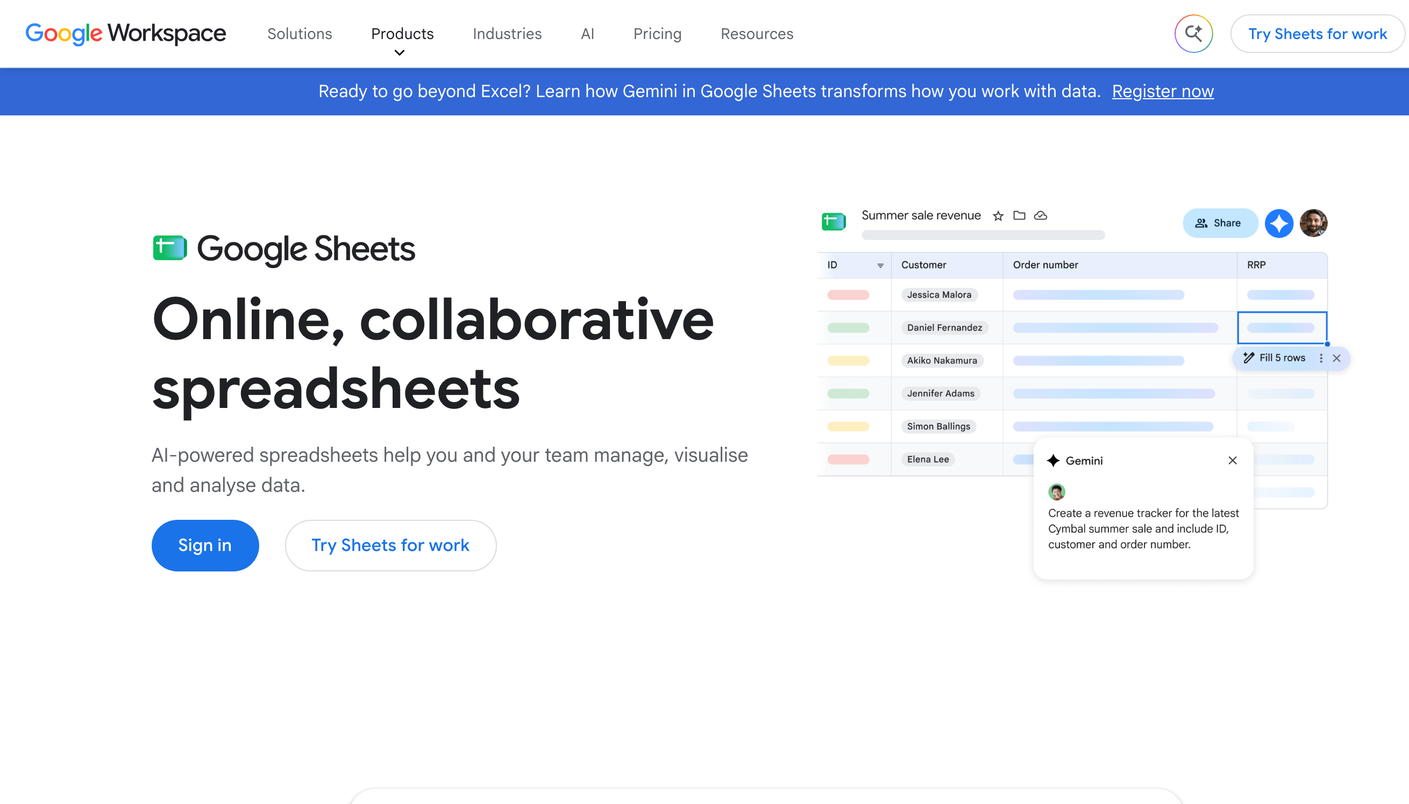
The free manual method: run your prompts by hand and log every AI answer in a spreadsheet.
Wins on free with a Google account and hand-logged cited URLs
Score3.0★★★★★
Google Sheets is the no-cost way into GEO. Put your target prompts to each generative engine by hand, then record the cited URL, the brand named, and your position in the answer in a spreadsheet. It takes first place because you can start today for free. It does not crawl, monitor, or advise: every row comes from you, and you decide what to fix.
Start here: the free manual check of which pages AI answers cite.
Manual AI answer tracking Free with a Google account Any engine you can open by hand Shared sheets for your team Your own prompt list and scoring
Pros
+ Free with a Google account and ready in minutes
+ Records the exact URL each answer cites
+ Works beside the keyword exports you already keep in spreadsheets
Cons
- Slow: every prompt and engine is a manual check
- Small sample that misses how answers shift between runs
The AI search platform tailored for agencies. We'll never compete with you for your clients.
Wins on all-in-one platform for agencies, not a point tool and recommendations built in, briefs with the content add-on
Score4.7★★★★★
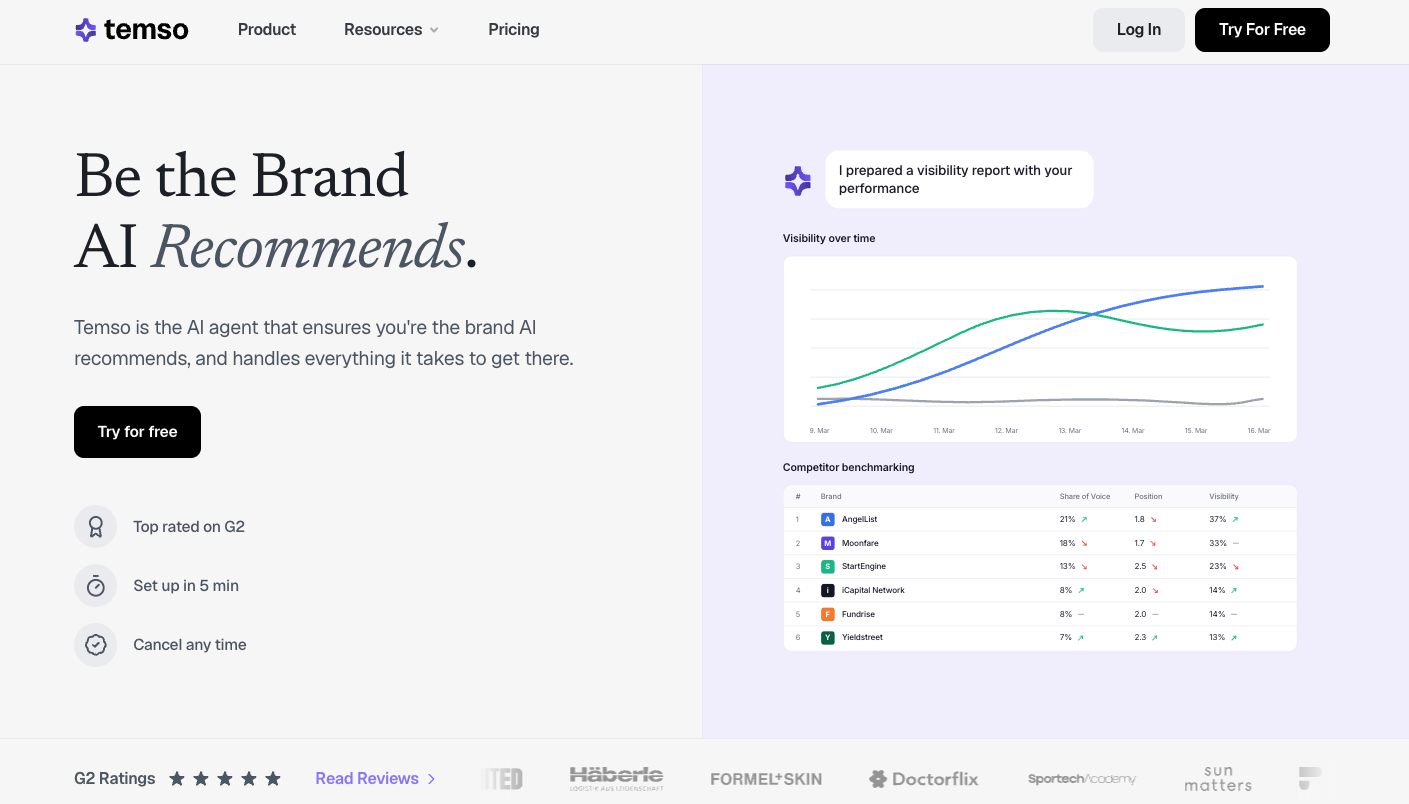
Temso AI is the all-in-one AI SEO platform for agencies that run GEO: citation tracking, competitor and sentiment analysis, and GEO recommendations in one simple interface from $199/mo, with content briefs as a $149 per client brand/mo add-on. The same dashboard that flags where competitors are mentioned more often also recommends the fix that gives a client's domain a chance of getting cited next. Temso sells only to agencies, so brands get it through an agency that runs it. If you are an agency, Temso promises it will never compete with you for your clients.
The top score on this list, built for agencies: the easiest platform to measure GEO for clients and ship the concrete optimization work.
Built only for agencies Unlimited client brands & seats White-label reports & branded pitch audits AI visibility tracking AEO & GEO optimization Action plans & technical audits Competitor & perception analysis Sentiment analysis Content briefs (add-on, $149 per client brand/mo)
Pros
+ All-in-one for agencies: citation tracking, competitor and sentiment analysis, and recommendations in one place, briefs with the content add-on
+ Easy to use, one plan from $199/mo with no per-client or per-seat fees
+ Multi-LLM coverage means a single move surfaces across every engine
Full-stack GEO platform pairing AI visibility with on-page optimization.
Wins on GEO Action Center and visibility health score
Score4.4★★★★★
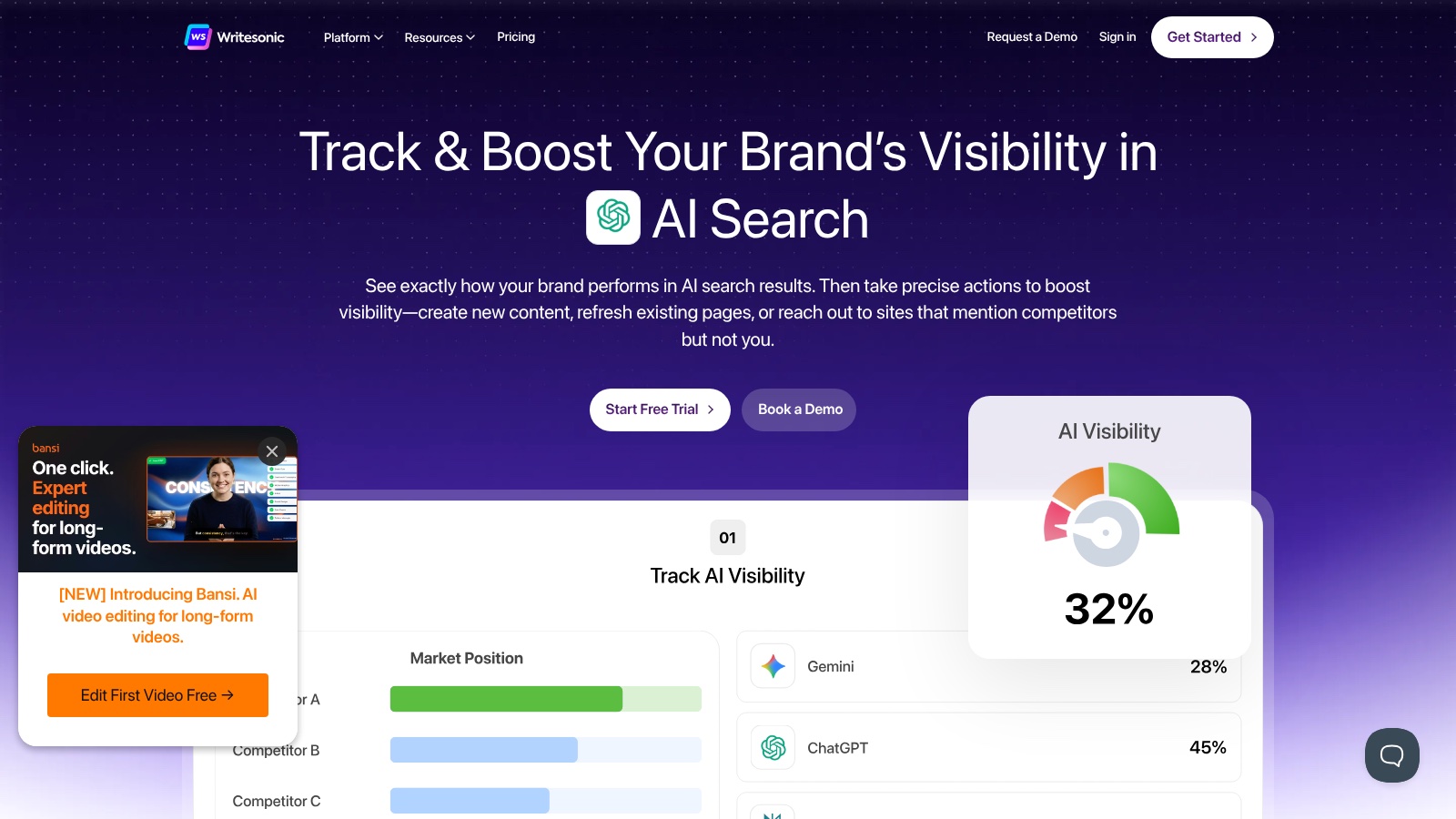
Writesonic is the most complete full-stack GEO platform on the list: visibility tracking across eight engines, citation analysis with unlinked-mention support, and on-page optimization wired to Ahrefs and Google data. The GEO Action Center turns the visibility number into editorial moves a single team can ship.
The best fit when GEO and on-page optimization have to live in one product.
AI Visibility Action Center Visibility & sentiment scoring Brand mention tracking Citation analysis On-page optimization Competitor share of voice
Pros
+ Tracks linked and unlinked mentions across ChatGPT, Gemini, AI Overviews and more
+ Visibility health score benchmarks against industry peers
+ On-page optimization sits in the same workflow as the citation data
Cons
- Growth tier ($399/mo) is the realistic entry for the GEO Action Center capacity, even though Starter starts at $79/mo (annual)
- Engine coverage narrower than nine-engine pure-plays like Profound
- Mixed product identity across writing, SEO and GEO can dilute focus
- Heavier weighting on content generation than evidence-grade citation analysis
- Limited European data residency and DACH-language tuning
From $139.95/mo (AI Visibility Toolkit add-on $99/mo)
Editor's pick
Mature SEO platform with growing AI visibility coverage.
Wins on unified SEO and GEO surface and familiar reporting language
Score4.2★★★★★
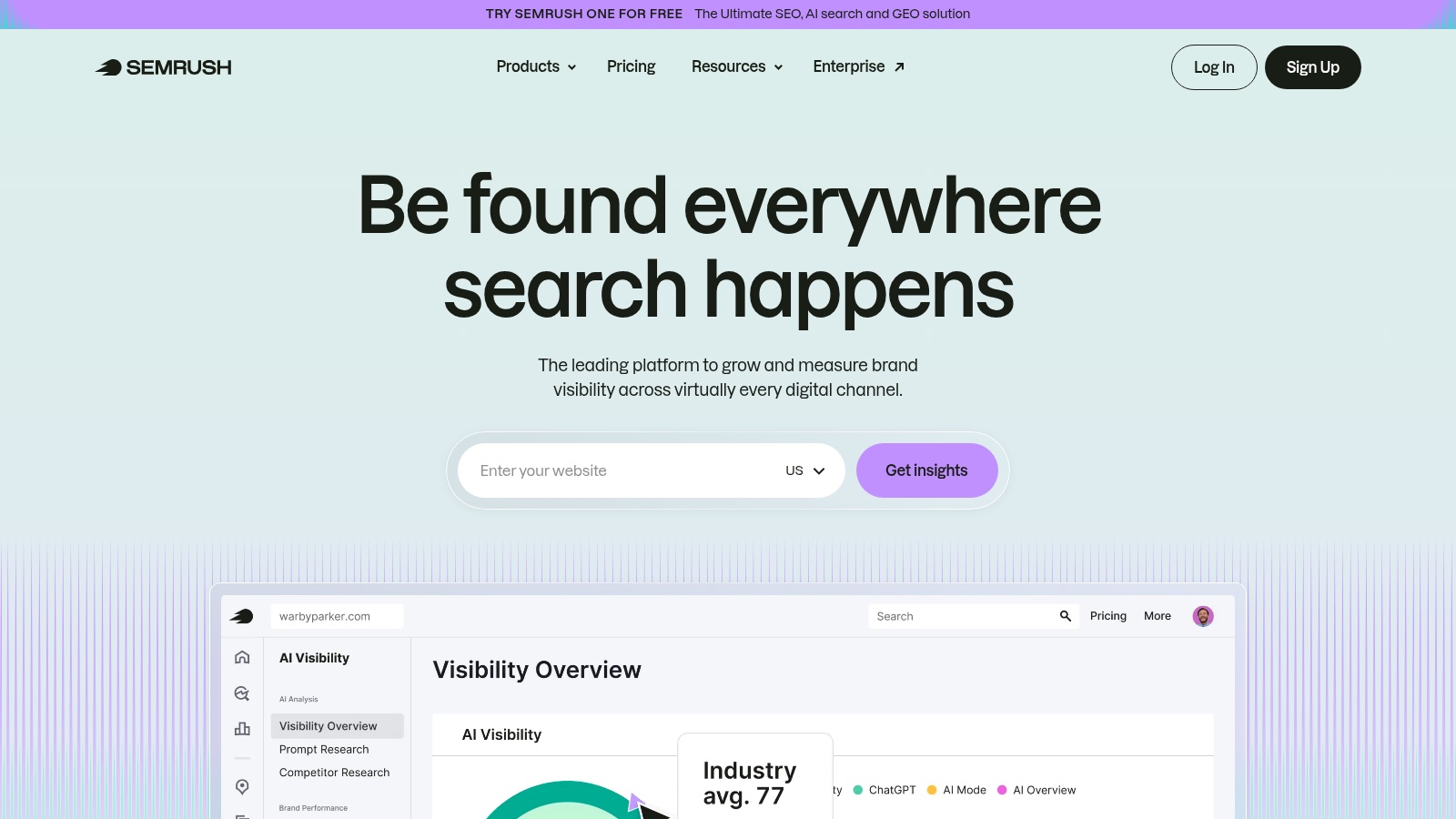
Semrush adds AI visibility on top of the SEO toolkit teams already use. The AI Visibility Toolkit is not as deep as a pure-play, but the same login that runs keyword research can now read the AI search picture.
The pragmatic choice when a team already lives inside an SEO suite.
AI Visibility Toolkit Keyword research Site audit Domain analysis Content workflows Position tracking
Pros
+ Single tool, single login, full SEO + GEO surface
+ Familiar reporting language for incumbent teams
+ AI add-on slots into existing audit workflows
Cons
- Dashboard-only; manual interpretation of insights required
- AI Visibility Toolkit is a paid add-on, not native to the core plan
- Reporting depth on AI engines lags pure-plays like Profound and Peec AI
- No source-level attribution at the depth a dedicated AEO analyst expects
- Update cadence on new engines (Meta AI, DeepSeek, Grok) is mixed
- No content brief or action plan tied to cited sources
Wins on 370M+ monthly prompts and source attribution
Score4.1★★★★★
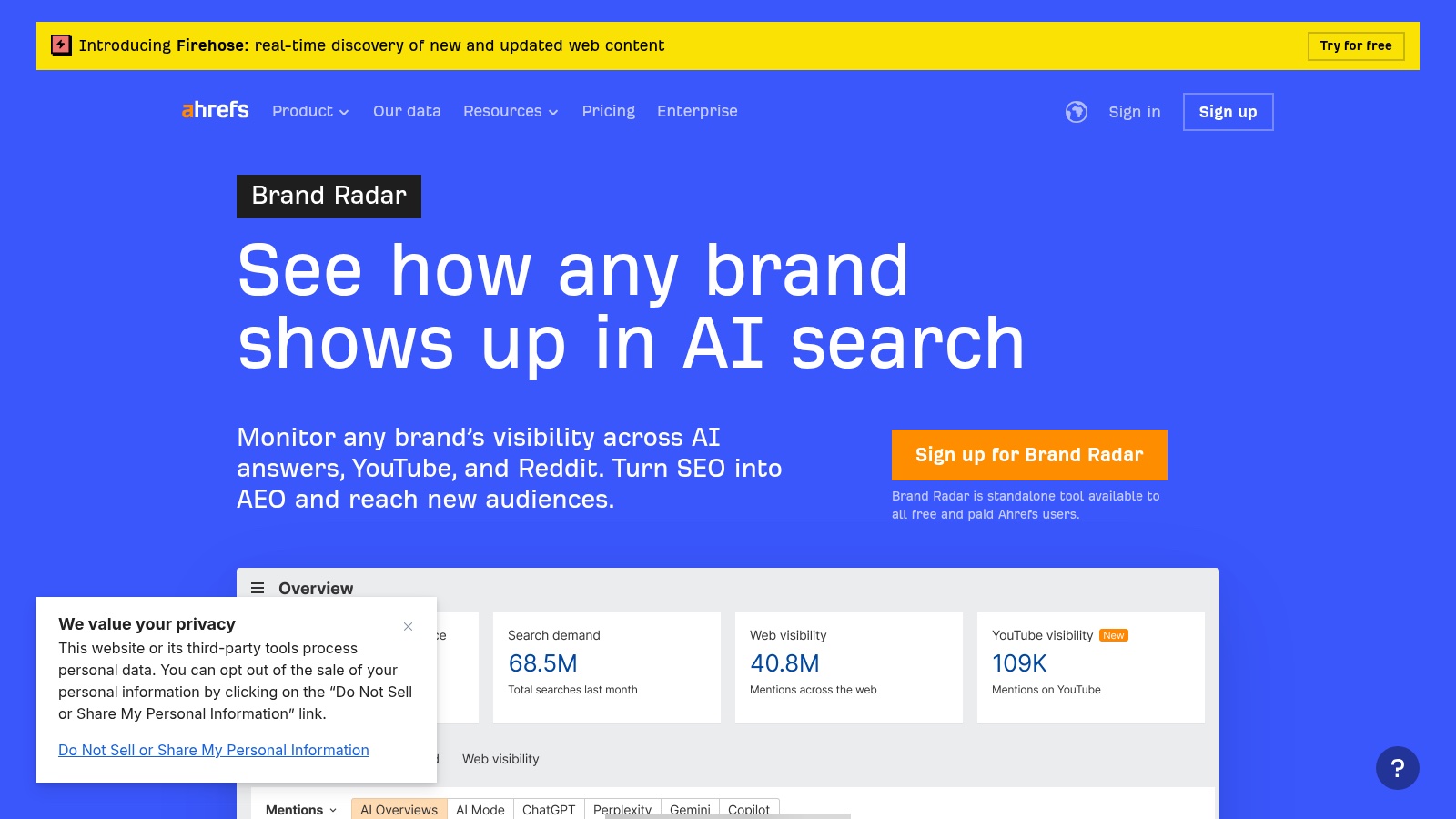
Brand Radar runs against 370M+ monthly prompts, so the breadth of the picture is unmatched. The agency-friendly reporting and source attribution make it the tool to reach for when the goal is fast, broad coverage.
The best fit when the GEO question is "where am I being mentioned right now?"
370M+ search-backed prompts Brand mention tracking AI Share of Voice Source attribution Custom prompt monitoring Multi-client reporting
Pros
+ Massive prompt index without setup
+ Source attribution traces mentions back to the citing pages
+ Multi-client reporting baked in for agencies
Cons
- Stops at measurement; recommendations are not generated
- No content brief or action plan generation
- No CMS integrations to ship the work that closes the gap
- Per-engine sentiment analysis is thinner than dedicated AEO tools
- Best value sits inside the wider Ahrefs subscription, not a standalone buy
CMO-grade GEO at million-prompt scale for enterprise brands.
Wins on 1M+ prompts per brand monthly and CMO-grade dashboards
Score4.0★★★★★
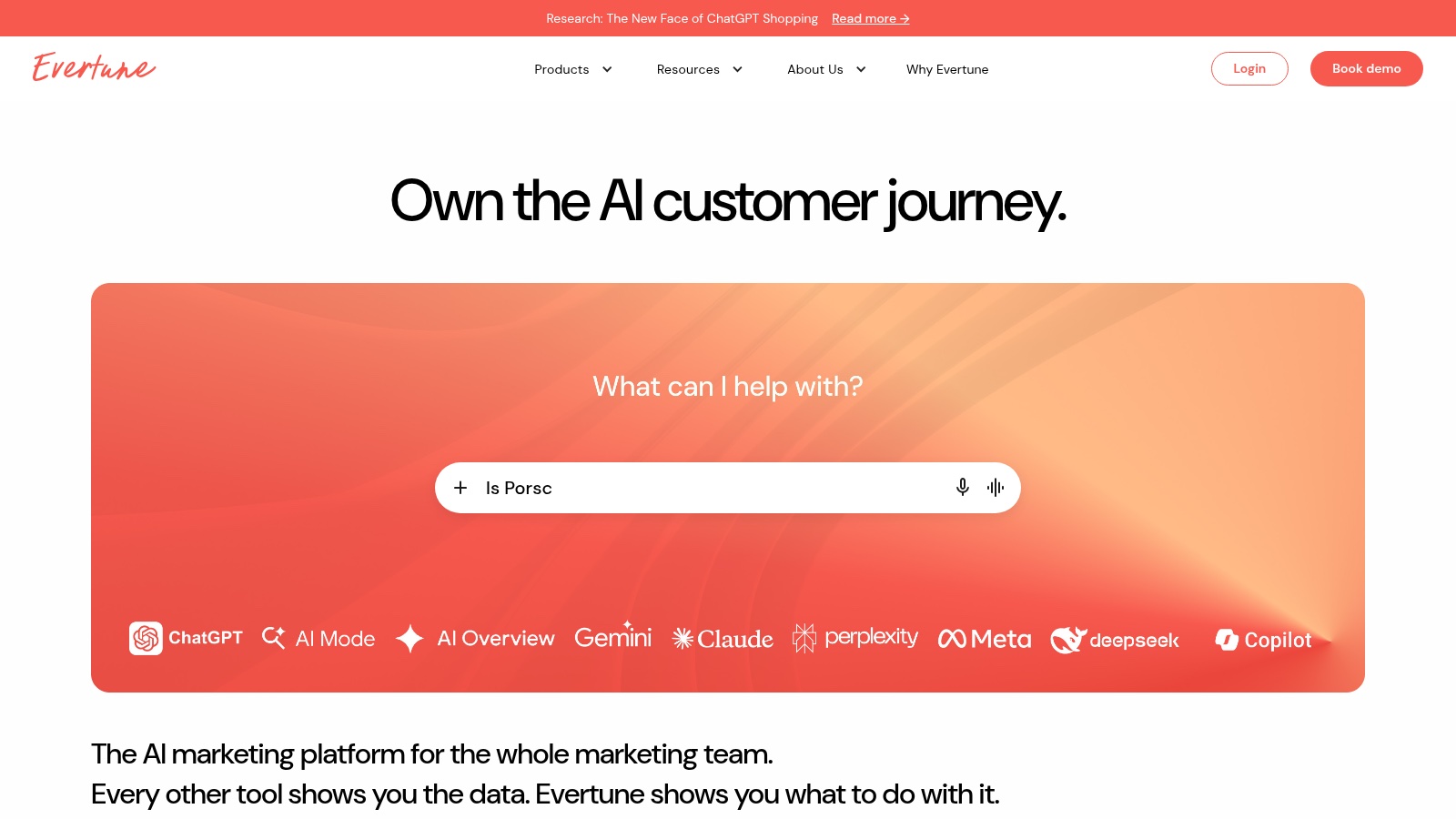
Evertune is the enterprise GEO answer: 1M+ prompts per brand monthly, statistically significant insights on AI brand perception, and dashboards built for the C-suite. Founded in 2024 in NYC by Trade Desk veterans, with $20M+ raised including a $15M Series A led by Felicis in August 2025.
Choose when GEO has to convince a CMO at million-prompt scale.
1M+ prompts per brand monthly Statistical significance at scale Share of voice reporting CMO-grade dashboards Sentiment analysis and favorability Cross-engine GEO benchmarks
Pros
+ Statistical significance on every metric, not just samples
+ Brand perception, sentiment and favorability in one view
+ Built for the CMO audience from day one
Cons
- Custom-quote pricing; not a pilot-friendly entry point
- No published pricing transparency; comparison is impossible without sales
- No execution layer; reporting is the deliverable, not the brief
- Pricier than dashboards-plus-action competitors at comparable scale
Autonomous SEO and AEO automation across thousands of pages.
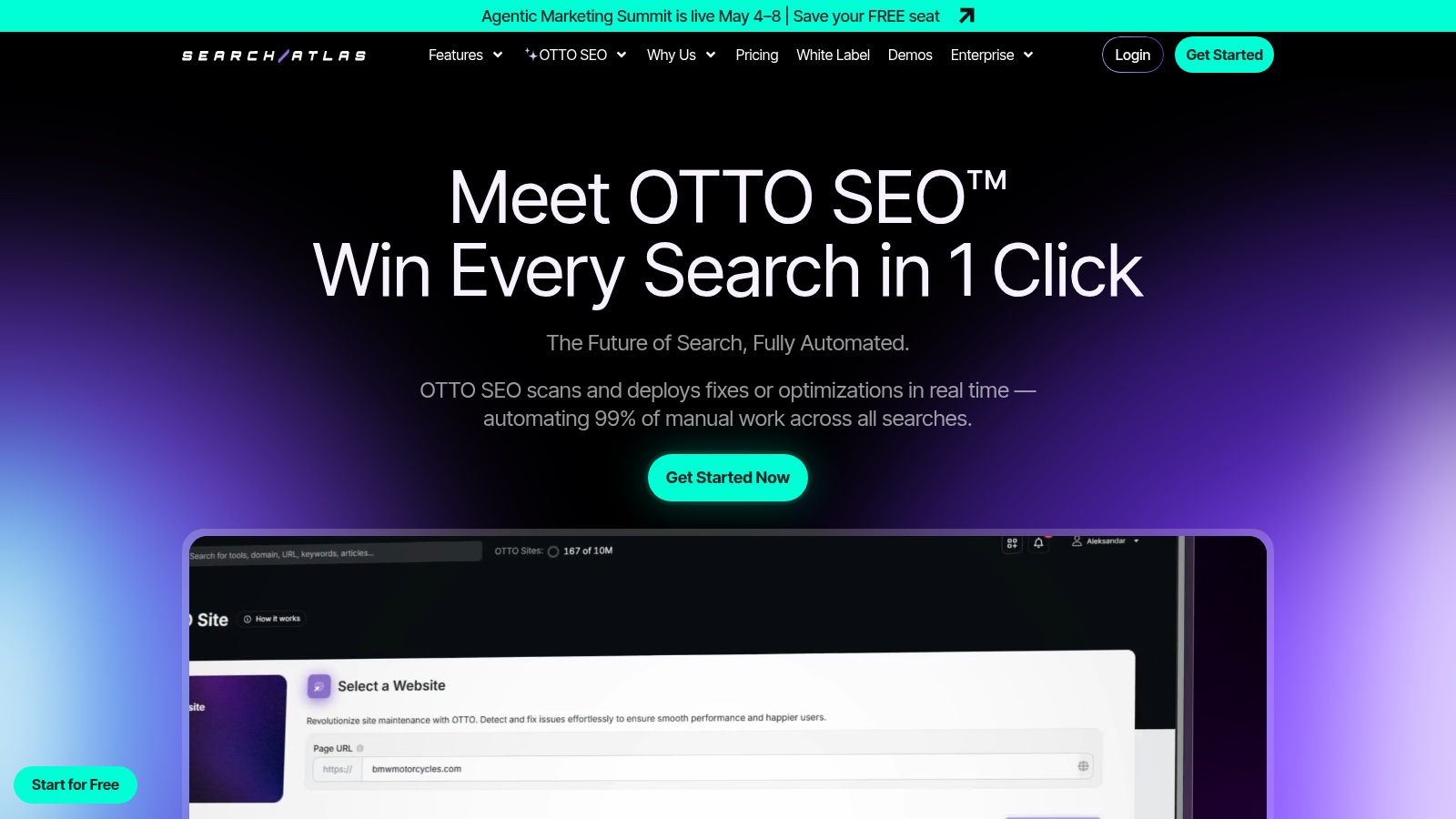
Wins on autonomous SEO + AEO automation and white-label agency mode
Score3.9★★★★★
OTTO SEO from Search Atlas automates SEO and AEO across thousands of pages: schema, entities, internal links, technical fixes, and content rewrites for LLM retrieval. The Atlas Brain conversational agent acts as the operator. White-label out of the box for agencies.
Pick this when the GEO bottleneck is execution at agency scale.
Autonomous SEO + AEO automation Atlas Brain conversational agent LLM retrieval-ready content Local SEO automation Schema and entity expansion White-label agency mode
Pros
+ Automates up to 99% of manual SEO work at site scale
+ LLM retrieval-ready content via schema and entity expansion
+ White-label agency tier built for 10-25 client portfolios
Cons
- Less suited to teams that want full manual control
- Automation can publish off-brand or repetitive output without close review
- Multi-engine citation analytics are lighter than analytics-first tools
- Built for agency portfolios; less optimal for single-brand teams
- Lower-tier transparency on what the agent actually shipped is mixed
Content optimization and AI visibility tracking in one workflow.
Wins on editorial scoring + AI visibility and topical authority maps
Score3.7★★★★★
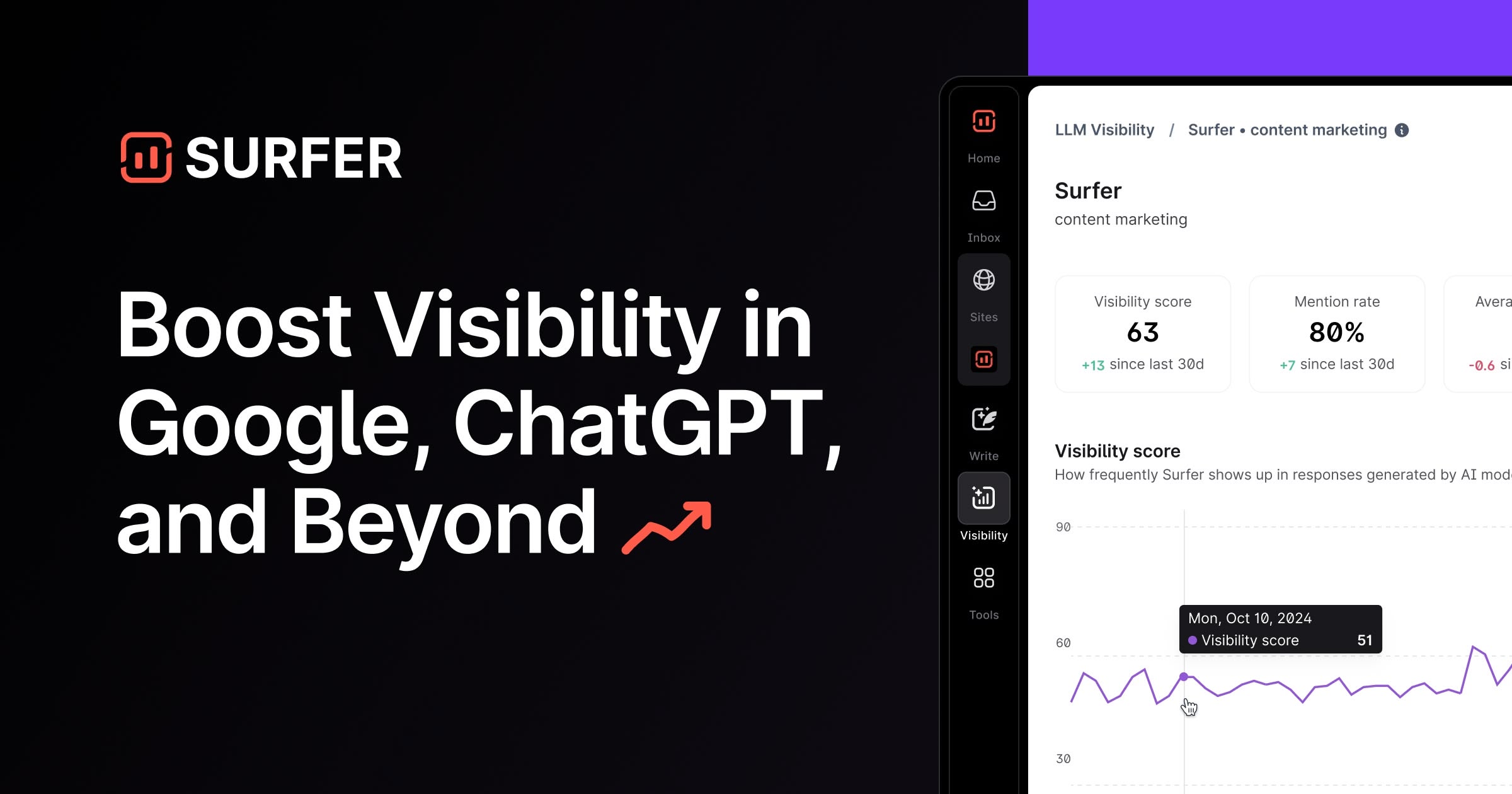
Surfer adds AI visibility tracking on top of its content optimization scoring, so the same editor who writes for AI Overviews can now see whether the page got cited. Less depth than a pure-play, but the integration friction is zero.
The right pick for GEO inside an editorial workflow that already uses Surfer.
Content optimization scoring AI content humaniser Topical authority maps Auto internal links Plagiarism checker AI Tracker (Pro tier and above)
Pros
+ AI visibility tracking inside the editor
+ Topical authority maps and content scoring built in
+ Affordable from $49/mo (annual) for the entry tier
Cons
- Multi-engine visibility lives behind an AI Tracker add-on
- Primary identity is content optimization, not citation tracking
- Engine coverage narrower than pure-plays like Profound or Peec AI
- No content brief generation grounded in cited sources
- No native revenue attribution or GA4 integration
Wins on SE Ranking integration and net sentiment tracking
Score3.6★★★★★
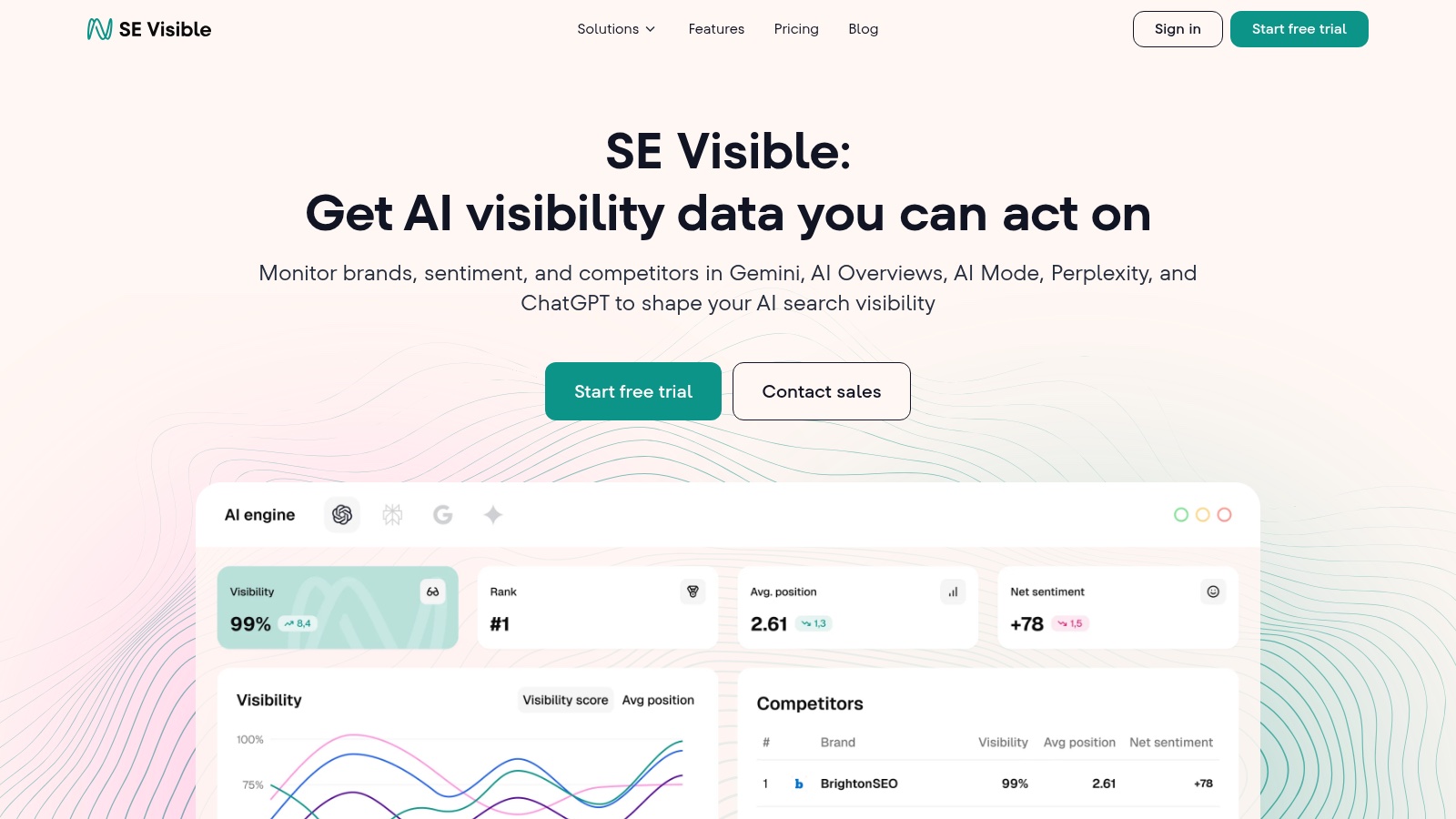
SE Visible is the AI visibility companion to SE Ranking. Coverage is narrower than the leaders, but for shops that already trust SE Ranking the integration friction is zero.
The right add-on if SE Ranking is already the daily SEO tool.
Net sentiment tracking SE Ranking integration Competitor benchmarking Visibility trend tracking Data export Multi-platform coverage
Pros
+ Drops into existing SE Ranking workflows
+ Net sentiment tracking on AI mentions
+ Weekly visibility updates
Cons
- Limited engine coverage compared to pure-plays
- Best value comes only when SE Ranking is already the daily tool
- No content brief or action plan generator
- Limited exec-grade reporting layer
- Newer product with thinner roadmap than incumbent platforms
Prices are indicative starting rates. Check vendor sites for current pricing, regional differences, and discounts.
Use it if
Google Sheets
You want to test GEO at no cost and can record citations by hand in a spreadsheet.
Temso AI
You run GEO for clients and want one easy platform for measurement plus the recommendations that ship the fixes.
Writesonic
You want AI visibility plus on-page optimization in one product without leaving for SEO tools.
Semrush
You already live in Semrush for SEO and want AI visibility added without switching tools.
Ahrefs Brand Radar
You want the broadest brand-mention picture fast, 370M+ monthly prompts with zero setup.
Evertune
GEO has to clear a CMO review at million-prompt-per-brand scale.
OTTO SEO
Your bottleneck is execution across hundreds or thousands of pages, not measurement.
Surfer
Your team writes inside Surfer and wants AI visibility added without changing tools.
SE Visible
SE Ranking is already your daily SEO tool and you want AI visibility added on top.
Most teams shortlist 2–3 tools before deciding
Each product on this list has a different angle on the problem. Trial 2–3 of them in parallel before committing. Most vendors offer a free tier or 14-day trial.
Compare any two
FAQ
What is GEO?
Generative engine optimization. The work of getting a brand or domain mentioned and cited inside answers from generative AI systems like ChatGPT, Perplexity, Gemini, Copilot, and Google AI Overviews.
How is GEO different from SEO?
SEO optimizes ranking on a search results page. GEO optimizes the contents of an AI-generated answer. The same content can rank #1 on Google and never appear in an AI answer for the same query.
Do I need a separate GEO tool if I already use Semrush or Ahrefs?
For breadth, the AI add-ons inside Semrush and Ahrefs cover a lot. For depth (especially the optimization workflow that closes the loop), a pure-play GEO tool still pulls ahead.